If you’ve noticed coffee shops offering beans with detailed information about their origin, processing method, altitude, and tasting notes, you’ve probably come across the term specialty coffee.
But what exactly does specialty coffee mean? Is it simply more expensive coffee, or is there something more behind the label?
Specialty coffee is generally associated with higher-quality beans, careful production, greater traceability, and a focus on preserving the unique characteristics of the coffee. It has become increasingly popular as more people discover that coffee can taste much more complex than simply “strong” or “bitter.”
What Is Specialty Coffee?
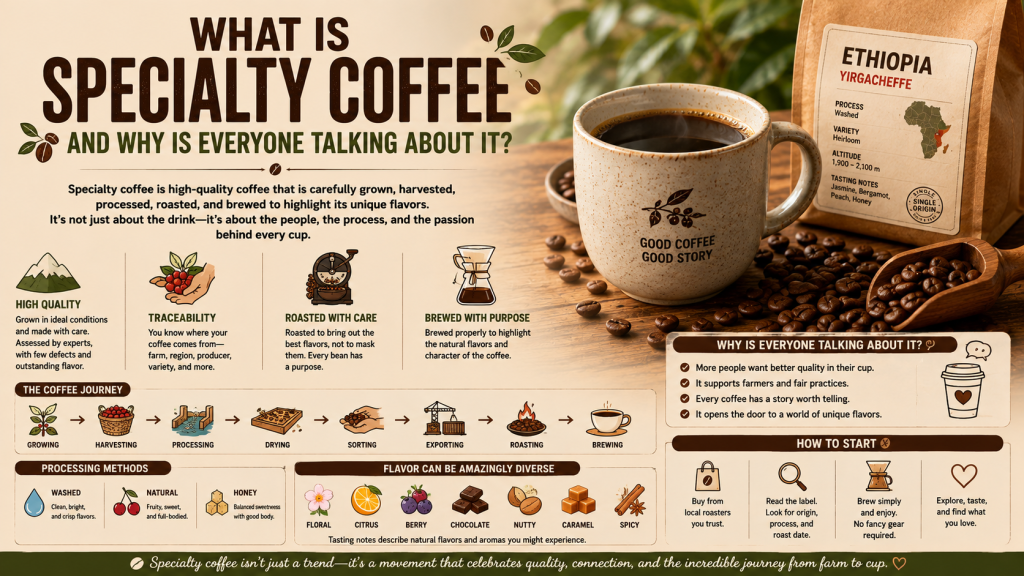
Specialty coffee refers to coffee that meets recognized quality standards and has been carefully produced throughout its journey from farm to cup.
The term is commonly used for coffee that has achieved a high quality score through professional evaluation and has relatively few defects. However, specialty coffee is about more than a score.
It can involve attention to every stage of production, including:
- Growing and harvesting
- Selecting ripe coffee cherries
- Processing the beans
- Drying and storing
- Exporting
- Roasting
- Brewing
The goal is to preserve and highlight the natural qualities of the coffee.
How Is Specialty Coffee Different From Regular Coffee?
The biggest difference is often the level of attention given to the coffee throughout its supply chain.
Commercial coffee is typically produced on a large scale, with consistency, availability, and affordability being major priorities.
Specialty coffee places greater emphasis on quality, flavor, traceability, and the characteristics of a particular coffee.
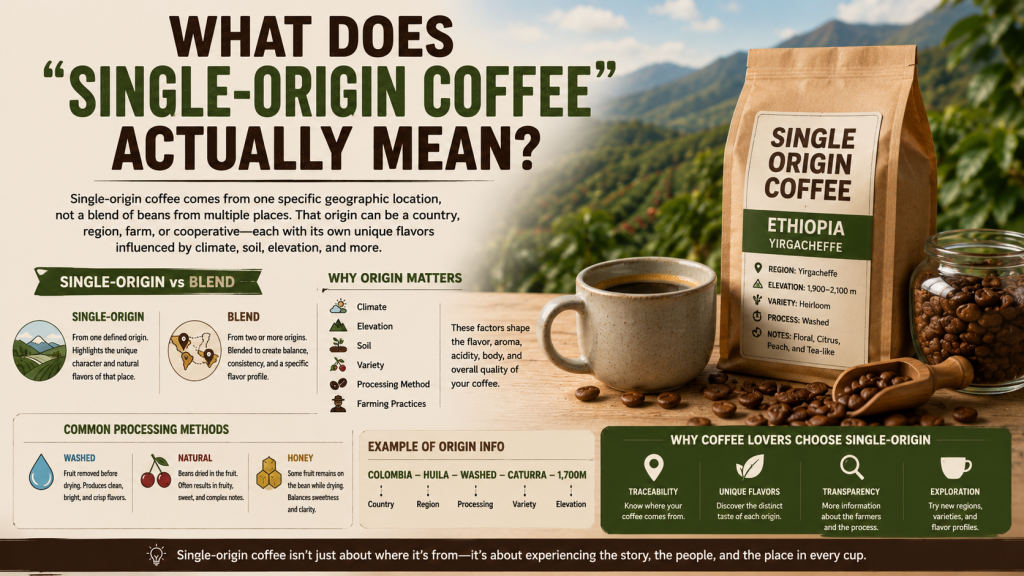
For example, instead of simply labeling a bag “Colombian Coffee,” a specialty coffee might provide information such as:
Colombia — Huila — Washed — Caturra — 1,700 meters
This gives the consumer a better idea of where the coffee came from and how it was produced.
Why Does Specialty Coffee Taste Different?
One of the main reasons specialty coffee can taste different is the quality and selection of the beans.
Coffee cherries are ideally harvested when they are ripe. Careful harvesting can help create a more consistent batch of coffee.
After harvesting, the beans are processed using methods such as washed, natural, or honey processing. Each method can influence the final flavor.
The coffee is then roasted to bring out desirable characteristics without unnecessarily overwhelming the natural flavors of the beans.
When brewed properly, specialty coffee can have a wide range of flavors.
You might taste:
- Chocolate
- Caramel
- Nuts
- Citrus
- Berries
- Stone fruit
- Flowers
- Spices
- Brown sugar
These descriptions aren’t necessarily ingredients added to the coffee. They describe aromas and flavors that can naturally occur in the beans.
What Does “Tasting Notes” Mean?
If you’ve ever seen a coffee bag with descriptions such as “blueberry, jasmine, and honey,” you might wonder whether the coffee actually contains those ingredients.
Usually, it doesn’t.
Tasting notes are used to describe flavors and aromas that people may perceive when drinking the coffee.
For example, a coffee might remind you of chocolate, citrus, or berries because of its natural flavor characteristics.
Taste is subjective, so you may not experience exactly the same notes as the person who wrote the description.
That’s part of the fun of specialty coffee.
The Importance of Coffee Origin
Where coffee is grown can have a major influence on its flavor.
Coffee plants grow in different environments around the world, particularly in regions known as the Coffee Belt, which includes parts of Central and South America, Africa, and Asia.
Differences in altitude, climate, soil, rainfall, and farming practices can influence how coffee develops.
For example, some Ethiopian coffees are often associated with floral and fruity characteristics, while coffees from Brazil can frequently offer chocolate, nutty, and sweet flavors.
These are general tendencies rather than strict rules. Every farm, region, variety, and processing method can produce something different.
Why Is Traceability Important?
Traceability is another important part of the specialty coffee experience.
When you know where your coffee came from, you can better understand the people and processes involved in producing it.
A coffee bag may provide information about:
- Country
- Region
- Farm
- Producer
- Cooperative
- Elevation
- Coffee variety
- Processing method
- Harvest period
This information creates a stronger connection between the coffee in your cup and the people who produced it.
What Is a Coffee Processing Method?
After coffee cherries are harvested, the seeds inside them need to be processed before they can be roasted.
Three common processing methods are washed, natural, and honey.
Washed Coffee
In washed processing, the fruit is removed from the coffee seed before drying.
Washed coffees are often associated with clean, bright, and clearly defined flavors.
Natural Coffee
In natural processing, the whole coffee cherry is dried with the fruit still surrounding the seed.
This method can produce fruity, sweet, and sometimes intensely aromatic flavors.
Honey Coffee
Honey processing removes some of the fruit while leaving some of the sticky mucilage around the seed during drying.
It can produce a combination of sweetness, body, and clarity.
The processing method is one of many factors that can influence how a specialty coffee tastes.
Does Specialty Coffee Always Taste Fruity?
No.
Specialty coffee can have many different flavor profiles.
If you prefer traditional coffee flavors, you can find specialty beans with notes of:
- Chocolate
- Caramel
- Almond
- Hazelnut
- Brown sugar
If you enjoy more unusual flavors, you can also find coffees with:
- Berry
- Citrus
- Tropical fruit
- Floral
- Tea-like characteristics
There is no single “specialty coffee taste.”
Why Is Specialty Coffee More Expensive?
Specialty coffee can cost more because producing high-quality coffee often requires additional care and resources.
Farmers may invest more effort in selective harvesting, processing, drying, and quality control.
Smaller specialty lots may also be produced in limited quantities, making them less widely available.
The price can reflect not only the coffee itself but also the work involved in producing, processing, transporting, roasting, and preparing it.
However, expensive doesn’t automatically mean better for your personal taste.
A more affordable coffee may still be the one you enjoy most.
Is Specialty Coffee Stronger?
Not necessarily.
“Strong” can mean several different things when talking about coffee.
It might refer to:
- Caffeine content
- Intensity of flavor
- Roast level
- Concentration
- Bitterness
Specialty coffee isn’t automatically higher in caffeine or more intense than commercial coffee.
In fact, many specialty coffees are roasted to preserve delicate flavors rather than create a very dark, bitter taste.
How Should You Brew Specialty Coffee?
Specialty coffee can be brewed using almost any method, but certain brewing techniques are particularly popular because they can highlight its flavor characteristics.
Pour-Over
Pour-over brewing is popular for coffees with delicate aromas and bright acidity.
It can provide a clean cup that makes individual flavor notes easier to notice.
French Press
French press brewing generally produces a fuller-bodied cup.
It can be a good choice for coffees with chocolate, nutty, or rich flavors.
AeroPress
The AeroPress is versatile and allows you to experiment with grind size, water temperature, brewing time, and coffee-to-water ratio.
Espresso
Specialty coffee can also be used for espresso.
Modern specialty espresso can feature flavors ranging from chocolate and caramel to fruit and floral notes.
Do You Need Expensive Equipment?
No.
You don’t need a professional espresso machine or an expensive grinder to start exploring specialty coffee.
A simple pour-over dripper, French press, or AeroPress can be enough.
However, a good grinder can make a noticeable difference because freshly ground coffee generally retains more aroma than pre-ground coffee.
The most important thing is to start with good-quality beans and learn how your brewing method affects the final cup.
How to Start Exploring Specialty Coffee
If you’re new to specialty coffee, don’t make it complicated.
Start by buying a small bag from a reputable local roaster.
Look for information about:
- Origin
- Roast date
- Processing method
- Variety
- Tasting notes
Then brew it using a method you’re already comfortable with.
Pay attention to what you taste. Is it sweet? Bright? Fruity? Chocolatey? Nutty? Does it have a light or heavy body?
You don’t need to identify every tasting note. Simply noticing how the coffee tastes is a great start.
Why Is Everyone Talking About Specialty Coffee?
Specialty coffee has become popular partly because people are becoming more interested in the story behind what they consume.
Coffee is no longer viewed simply as a source of caffeine. For many people, it has become an experience.
People want to know:
Where was the coffee grown?
Who produced it?
How was it processed?
How was it roasted?
Why does it taste the way it does?
Specialty coffee provides an opportunity to explore these questions while discovering flavors that you may never have associated with coffee before.
Final Thoughts
Specialty coffee is more than a trendy label. It represents a greater focus on coffee quality, careful production, traceability, and the unique characteristics of beans from different origins.
It doesn’t mean every specialty coffee will automatically taste better to everyone. Coffee is personal, and the best coffee is ultimately the one that matches your preferences.
If you’re curious about specialty coffee, start simple. Try beans from different origins, experiment with brewing methods, and pay attention to the flavors in your cup.
You may discover that coffee has a much wider world of flavors than you ever expected.